
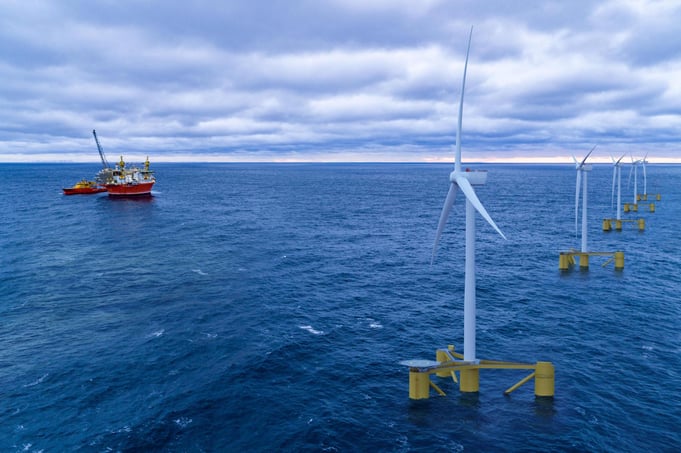
Illustration from GoliatVIND project at Barents Sea with Odfjell Oceanwinds DeepSea Star™ foundation.
Why demonstration projects are the pilot plants of floating wind
Floating offshore wind (FOW), a frontier technology poised to revolutionize our energy systems, is entering a new phase. Around the world, governments and developers are preparing for utility-scale deployment, with ambitions reaching hundreds of megawatts. France’s AO9 licensing round is set to award up to 2.5 GW of floating capacity across four sites later this year. In the UK, Green Volt is on track to become Europe’s first commercial-scale floating wind farm, delivering 560 MW. And in South Korea, Bandibuli (Firefly) is being developed by Equinor as part of the Ulsan cluster, with a planned capacity of 750 MW.
These are exciting projects, and their success will be critical to the future of offshore wind. But as the industry scales up, we must also ask: are we ready to deploy technologies that have yet to be proven on a commercial scale? Most existing floating wind farms use turbines rated 10 MW or less and consist of fewer than six units. Hywind Tampen, with 11 turbines, is the largest to date, but its concrete spar foundation is tailored to Norwegian conditions and not easily scalable elsewhere.
At Odfjell Oceanwind, we believe the answer lies in learning by doing. And doing so at a manageable scale.
A Lesson from Pharmaceuticals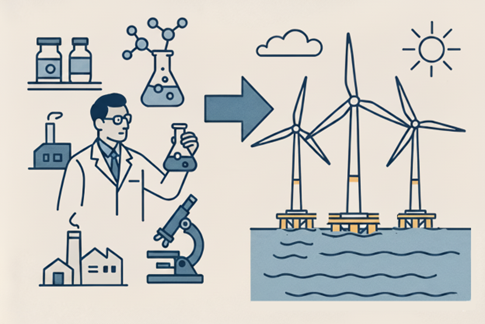
Scaling innovation
Many of the challenges facing floating wind, from scaling production to de-risking a complex supply chain, have already been navigated by another highly regulated and capital-intensive industry: pharmaceuticals. The parallels are more than metaphorical and can offer a proven blueprint for success.
Consider the journey of manufacturing a new drug. A promising compound is first synthesized in tiny quantities in a lab. At this stage, the focus is on the chemical reaction itself, not the economics or logistics of mass production. The true test comes with scaling. A process that works flawlessly in a small flask can become unstable or inefficient in a 10.000-liter reactor due to changes in heat transfer, mixing, and pressure.
This is where the pilot plant becomes indispensable. An intermediate-scale facility allows engineers to identify and solve unforeseen technical problems, optimize the process, and refine the manufacturing protocol before committing to a full-scale, multi-billion euro factory.
Floating wind follows a similar trajectory. A single prototype turbine proves the concept, but offers limited insight into the challenges of a commercial-scale farm. A demonstration project with 5–6 turbines is the equivalent of the pharmaceutical pilot plant: the proving ground for the complex, non-linear challenges of full-scale deployment. It’s where developers test the installation of massive steel components, validate mooring systems, and refine marine operations that cannot be accurately modelled in a lab. Further it allows for some elements of serial production compared to a single prototype.
Just as pharmaceutical companies use pilot plants to build resilient supply chains, floating wind developers should use demonstration projects to forge strong relationships with fabrication yards, port operators, and installation specialists. These early collaborations ensure that when the time comes for a 30-turbine farm, the logistical, commercial, and contractual framework is fully prepared.
Our Demonstration Projects: Learning by Doing
We have been working on GoliatVIND since April 2023. This 75 MW demonstration project will test our DeepSea Star™ foundation for relevant Wind Turbine Generator (WTG) sizes in harsh metocean conditions in the Barents Sea. Already, we’re seeing valuable learning from engaging with the supply chain and we look forward to validating the technology once the project moves forward. As many will know, the project is currently awaiting clarity around power offtake, which remains a key enabler for the development.
In May, we announced our option for a pilot project at Marine Energy Test Center (METCentre), with a capacity of up to 24 MW. This site will allow us to test relevant-sized WTGs in a controlled environment, further strengthening our readiness for utility-scale deployment.
And a few weeks ago, we announced the acquisition of Ørsted’s 80% share in the 100 MW Salamander project in Scotland. Located in one of the world’s leading regions for floating offshore wind, Salamander benefits from highly competent project partners and proximity to future large-scale developments.
These demonstration projects will allow us to:
- Validate the performance of relevant-sized WTGs on floating foundations
- Develop bankable delivery models, supply chain strategies and commercial models
- Reduce technical and financial risk for future utility-scale developments
- Build operational experience in real conditions
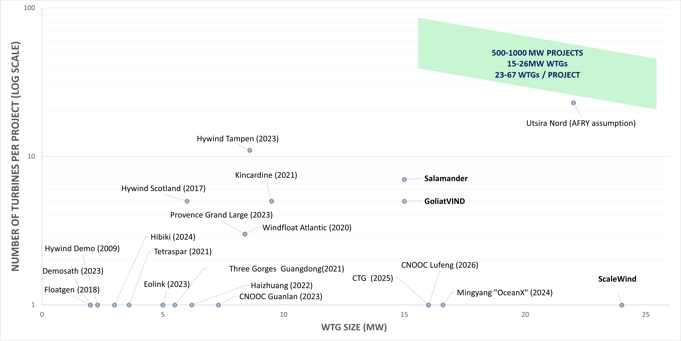
Most floating wind projects use turbines below 10 MW and fewer than six units. No project yet combines multiple turbines with 15+ MW capacity. Odfjell Oceanwind’s demos aim to bridge that gap.(Illustration from Odfjell Oceanwind)
Building for the Future
Demonstration projects are strategic investments in the future of floating offshore wind. They allow us to validate technology in real conditions, build resilient supply chains, and establish the commercial frameworks needed for scale. The lessons learned - from fabrication and installation to operations and logistics — will be instrumental in reducing risk, cost and accelerating deployment in utility-scale projects.
As the industry moves toward larger and more ambitious developments, we’re proud to be laying the groundwork. Because when it comes to innovation, early-stage learning with relevant technologies is the foundation for success.